
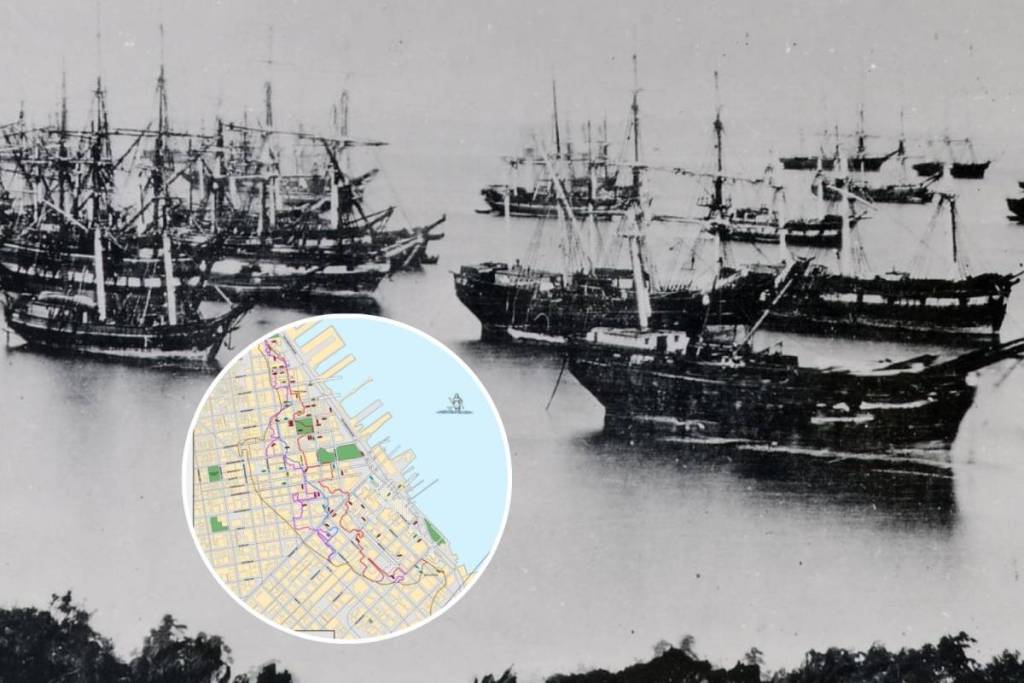

Did you know that much of today’s Embarcadero was once underwater? During the California Gold Rush, thousands of people poured into San Francisco, leaving more than a thousand ships abandoned along the shoreline. Over time, this dramatically altered the waterfront, and today the city stands atop those long-forgotten vessels from nearly two centuries ago.
In 2023, author Ron S. Filion published a new map, Buried Ships of San Francisco, which catalogs more than 70 ships still buried beneath the city’s streets. The map traces the shifting shoreline between 1849 and 1857 and highlights both confirmed and suspected locations of these hidden ships.
Among the discovered vessels are the Rome, located underground across from the Ferry Building; the Arkansas, on the same block as the Old Ship Saloon (itself built from an abandoned ship); and the Apollo, buried beneath the Federal Reserve Bank Building. You can explore the map below.

Filion originally created the Buried Ships of San Francisco map for his 2023 book of the same name, available on Amazon. The book dives deeper into the histories and origins of more than 180 Gold Rush-era ships that ultimately met their fate in San Francisco.
The National Park Service released a similar map in 2017 documenting abandoned ships beneath the city, which you may have seen at the San Francisco Maritime National Historical Park. Filion told us that while his 2023 map draws on some of the same primary sources used by the NPS, it also incorporates newer research from the U.S. National Archives, libraries in Berkeley and Los Angeles, and extensive newspaper records.
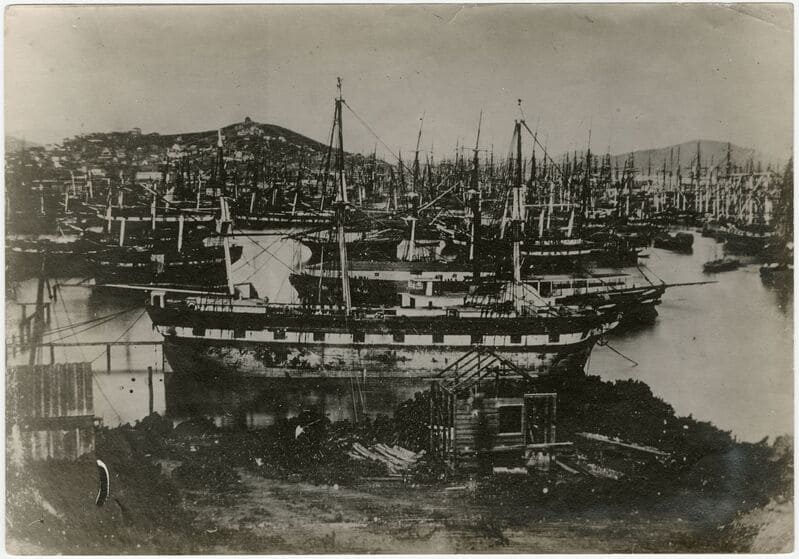
Some additional historical context…
If you’re interested in local history, you may know that San Francisco was originally called Yerba Buena after Mexico gained independence from Spain in 1821. In 1846, during the Mexican-American War, Captain John B. Montgomery claimed the town for the United States.
He raised the American flag over the central plaza, later named Portsmouth Square after his ship, the U.S.S. Portsmouth. Soon after, Yerba Buena was renamed San Francisco, the Gold Rush began, and the city transformed almost overnight.
By 1849, San Francisco’s population had surged from fewer than 1,000 residents to more than 25,000, fueled by the arrival of “forty-niners.” This massive influx brought countless ships to the shoreline—permanently reshaping it in the process.