


Over 20 research and conservation organizations from four countries are currently collaborating on a revolutionary new monarch butterfly tracking study.
Scientists tagged 400 of the delicate insects with ultralight transmitters to help follow their annual migration this year, shedding new light on their movements and patterns.
The Project Monarch app allows smartphones to act as mini receivers, which helps researchers track the tagged butterflies in real time. More on that below…
“The most comprehensive tracking study of monarch butterfly migration ever conducted”
Since 1997, the Xerces Society’s Western Monarch Count has organized a formal count of the monarch populations in coastal California and Baja each year.
But this new tracking study, Project Monarch, is already offering unprecedented insights into the butterflies’ migration patterns. The project is led by Cellular Tracking Technologies (CTT) and the Cape May Point Arts & Science Center (CMPASC), in collaboration with over 20 organizations, including the Xerces Society.
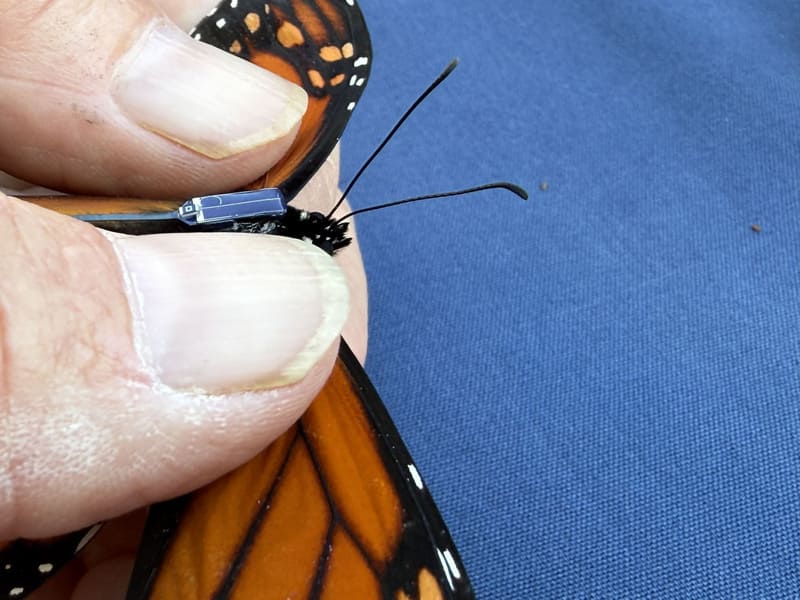
The insects are tagged with ultralight, solar-powered BlūMorpho transmitters weighing just 60 milligrams, which can be detected by everyday cellular-connected devices with Bluetooth capabilities and location enabled. Millions of smartphones across the country can thus act as a continent-wide, crowdsourced tracking network.
“The tagged butterflies will help us understand when and where monarchs move among overwintering sites and the surrounding areas,” said Emma Pelton, senior conservation biologist with the Xerces Society. “These details will help us identify where to prioritize conservation of western monarch habitat, as well as provide the most accurate picture of their home range to date.”
Scientists have tagged numerous insects nearby in Santa Cruz, where you can see several thousand butterflies overwintering right now.
Project Monarch app
Members of the public can participate by downloading the free Project Monarch app onto their phone, which allows Bluetooth-enabled phones to act as mini receivers for the tagged monarchs.
“This revolutionary approach can potentially create the largest wildlife tracking receiver network in the world,” reads the app description, “but only if members of the public download and use the free Project Monarch app.”
The app includes a detection screen, a map showing where tagged monarchs have been spotted, and even a detection leaderboard.
California’s monarch butterfly migration over the decades
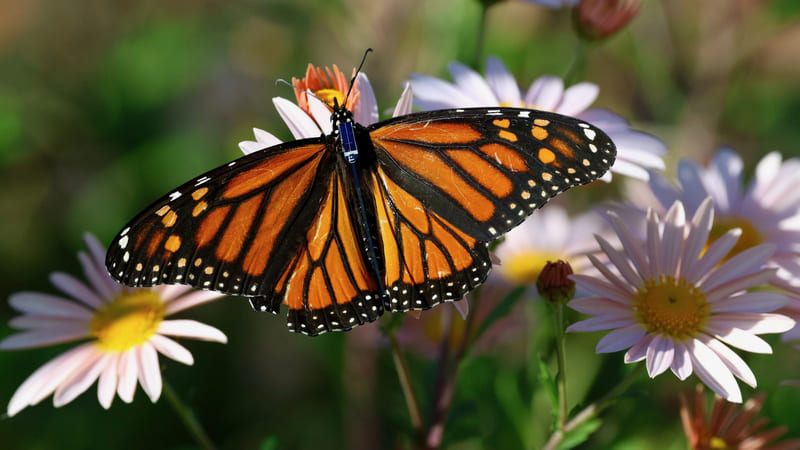
Monarch butterflies travel from locations throughout North America and the Caribbean to their overwintering sites in Mexico and California, clustering together and entering a dormant state through the cold months.
In the 1980s, California’s skies were filled with 4.5 million monarch butterflies each year, a number that slowly declined over the years until a 95% population crash in the 2010s. In the winter of 2020-2021, monarch butterflies reached near extinction, with only 2,000 individuals counted.
Populations unexpectedly rebounded up to 335,000 in 2022, before dipping down again. So far in 2025, the Xerces Society has only counted about 8,000 butterflies in California.
The monarchs’ story isn’t finished yet. You can help save the monarchs by joining the Xerces Society’s Western Monarch Call To Action, or downloading the Project Monarch app to help researchers learn more about their migration.