

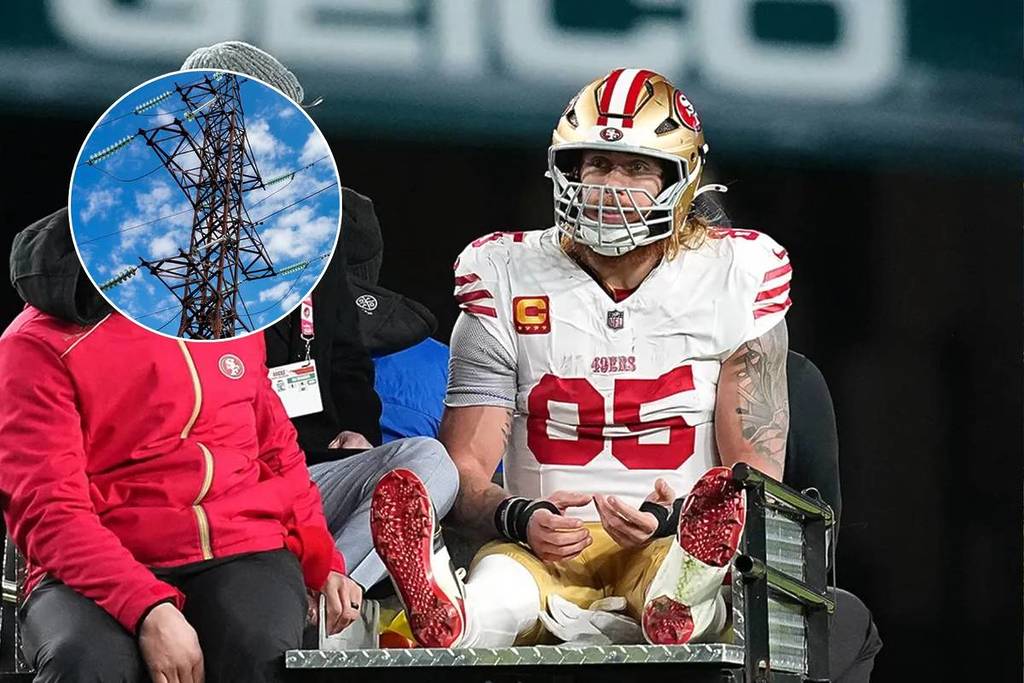
The San Francisco 49ers are known for a few things: a legendary legacy, a powerhouse roster, and a seemingly never-ending list of injuries. Since 2017, the Niners have statistically been the most injured team in the NFL, a trend that reached a heartbreaking peak this January at their training base in Santa Clara when star tight end George Kittle suffered a season-ending Achilles tear.
While fans have spent years blaming the strength and conditioning staff or the “Levi’s Stadium turf curse,” a startling new theory suggests the culprit isn’t in the weight room. It’s right next door.
The “Sci-Fi” Secret Hiding At The NFL Santa Clara Facility
If you look at an aerial view of the 49ers’ practice facility in Santa Clara, you’ll notice something strange. Bordering the fields is a massive electrical substation. A recent investigation by researcher Peter Cowan has sparked a “sci-fi” level of concern regarding the health of the players. According to Cowan, the radiation levels on the practice field are anything but normal.
Using a gaussmeter, he found that radiation levels on the far edge of the field measured over 8.5 milligauss, while inside the facility, levels reportedly spiked between 10-25 mG.
For context, typical background exposure is usually between 0.5 and 3 mG. This means players are practicing in environments with up to eight times the typical radiation levels.
Why This Matters (The “Cold War” Science)
The government maintains that these levels are safe because they aren’t high enough to cause thermal burns to the skin. However, experts argue that this standard is based on outdated Cold War-era science that doesn’t account for long-term biological effects. Modern research suggests that while this specific type of low-frequency radiation doesn’t burn you, it can silently weaken collagen.
This is particularly concerning because collagen is the literal glue that holds tendons and ligaments together. If radiation exposure is making these tissues more fragile on a cellular level, it creates a recipe for the exact types of non-contact injuries. This could explain the Achilles and ACL tears, which have plagued the Niners for years.
These levels are even reported to spike higher during periods of peak grid demand. This potentially puts players at even greater risk during specific times of the day.
Whether it is a wild coincidence or a legitimate environmental hazard, the “Power Grid” might be the toughest opponent the 49ers face this postseason.