
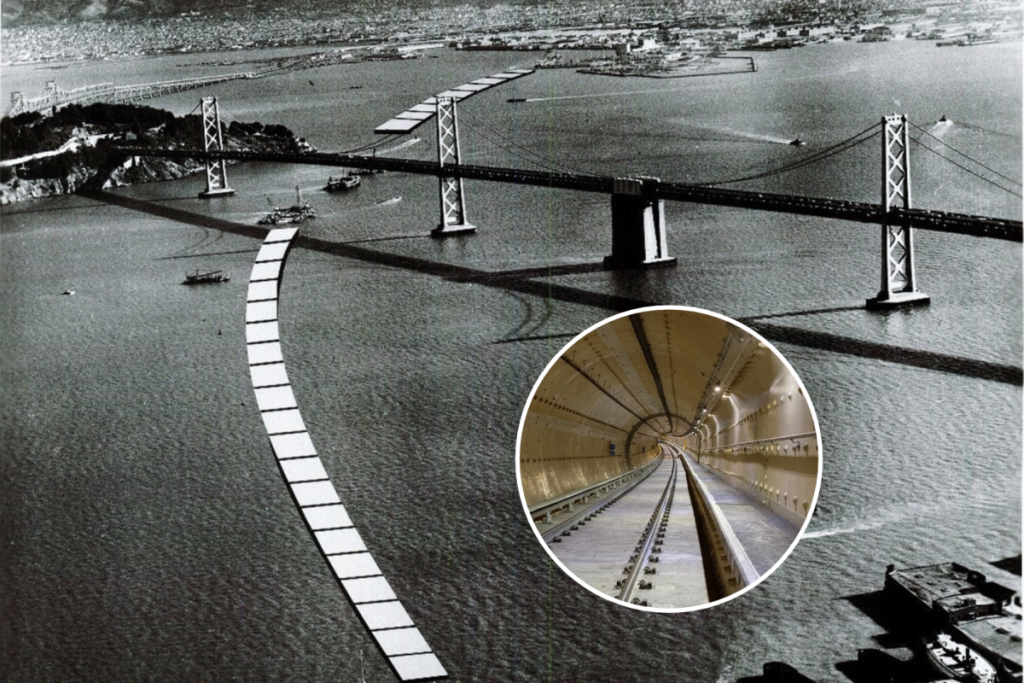

Resting 135 feet beneath the surface of the San Francisco Bay, BART’s 3.6-mile Transbay Tube is an engineering feat connecting San Francisco and Oakland. This underwater tunnel safely carries up to 24 trains and 28,000 commuters along the seabed every hour.
In honor of the 52nd anniversary of the famous tunnel’s debut this September 16th, we’re taking a closer look at the Transbay Tube, which continues to be one of the world’s most significant transit structures.
Building the world’s longest underwater transit tunnel
BART writes that one could attribute the first idea for the Transbay Tube to Emperor Norton, an eccentric SF resident who proclaimed himself “Emperor of the United States” and “Protector of Mexico” in 1859. Even though he had no real power, he was known for issuing humorous unofficial “decrees,” including an 1872 request for an underwater tunnel connecting San Francisco and Oakland.
Incidentally, his outlandish proposition was eventually rendered into reality in 1947 when a joint Army-Navy commission launched plans to mitigate Bay Bridge traffic with an underwater tube.
Construction began in 1965, a complex process of dredging 5.7 million cubic yards of mud, fabricating 57 330-foot-long tube segments, and lowering the segments onto the bay floor, which were guided into place by expert divers.
After four more years spent installing tracks and equipment, BART finally sent its first train through the tube in 1973. Regular passenger service began on September 16, 1974, exactly 52 years ago.
At the time, BART’s Transbay Tube was recognized as both the world’s longest underwater transit tunnel and the world’s largest and deepest immersed tube.
In 2010, however, the record was surpassed by several massive transit tunnel projects. Now, the world’s longest underwater transit tunnel is the Seikin Tunnel in Japan, which stretches an unbelievable 23 miles.
Design, features, and seismic safety
The Transbay Tube measures 48 feet across with two interior tunnels traveling in each direction. They flank an interior gallery used for maintenance, ventilation, and emergency escape.
In the case of a major earthquake, the Transbay Tube allows for 6 degrees of movement. Additional recent seismic retrofits include a new steel liner in critical sections and new water pumping systems.
Even 52 years after it first opened, the Transbay Tube remains one of most remarkable transit achievements in history, influencing the future of transportation all over the world.