
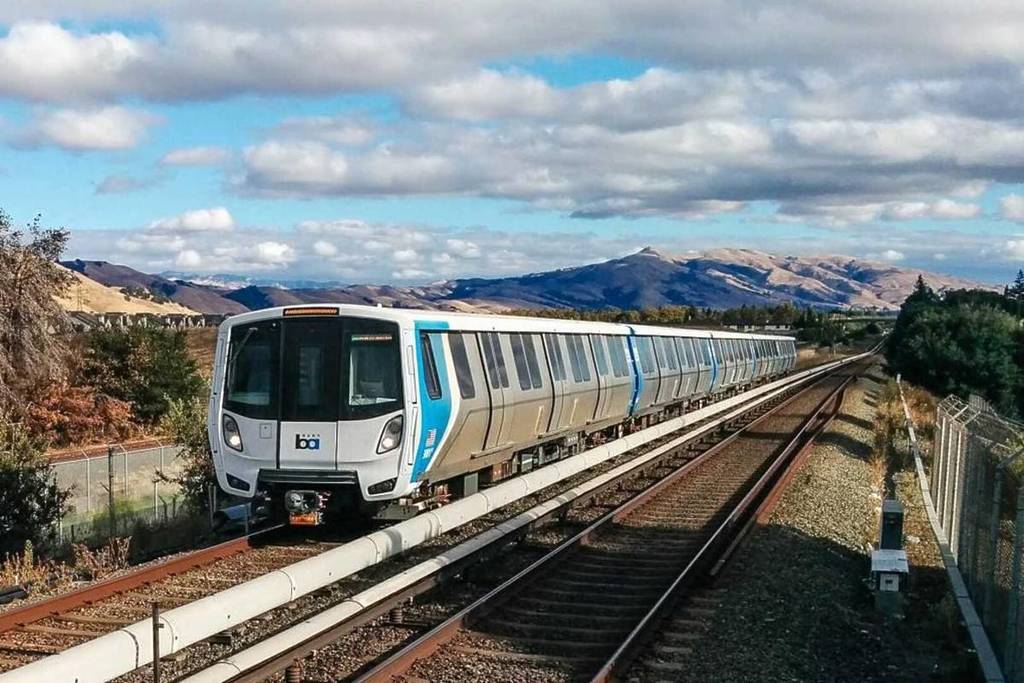

When BART ridership collapsed in 2020 during the pandemic, the system depended heavily on federal COVID relief to plug the gaps. Now, ridership has only recovered to about half of pre-pandemic levels, and those emergency funds can delay the proverbial “fiscal cliff” no more.
BART is still looking at a $376M deficit for the next fiscal year, despite implementing cross-departmental budget cuts, renting out its parking lots, and trying a range of cost-cutting measures. In February, the BART Board of Directors initially approved an “Alternative Service Plan,” which many have deemed a “doomsday plan,” which would cut services, close stations, increase fares, and lay off employees.
What happens next will depend on whether voters pass the “Connect Bay Area” measure, which regional groups are working to get on the November ballot.
Connect Bay Area: What’s on the ballot?
The “Connect Bay Area” measure proposes a half-cent sales tax in Alameda, Contra Costa, San Mateo, and Santa Clara counties, and a one-cent sales tax in San Francisco, for 14 years. This would raise about 1 billion dollars a year for Bay Area transit, including BART, Muni, AC Transit, Caltrain, and others.
About $310 million of that yearly sum would go to BART, closing most (but not all) of its long‑term deficit, and preventing the “doomsday” cuts.
While supporters frame Connect Bay Area as a life-or-death, “save transit” measure, opponents criticize the tax increases and question the agencies’ ability to manage the budget.
Alternative Service Plan: What changes in 2027 if cuts hit?
If the measure does not pass, BART’s Alternative Service Plan would kick in, which would roll out in two phases as summarized below. The plan involves laying off 1,200 employees, a 40% reduction in system support services, and more.
Phase 1: January 2027
Phase 1 would implement the following changes in January 2027. These changes would reduce train hours by 63%, targeting about $30M in savings over 6 months.
- Reduce BART service to the Yellow, Blue, and Orange lines
- Keep the Red and Green lines only for limited peak service in peak commute directions
- Reduce train frequency to every 30 minutes
- Close BART at 9pm seven days a week
- Increase fares and parking fees by 30%
Phase 2: July 2027
Following the January cuts, BART would assess ridership and revenue impacts, and then implement Phase 2 if “feasibly safe.” These additional cuts would reduce service by 70%, targeting over $175M in annual cost reductions.
- Maintain 3-line service with 30-minute freqencies, closing at 9pm
- Increase fares and parking fees by up to 50%
- Close up to 15 stations and/or up to 25% of system track miles
- While still not officially confirmed, the short list for station closures includes Pittsburg Center, North Concord/Martinez, Orinda, South San Francisco, San Bruno, Castro Valley, West Dublin/Pleasanton, South Hayward, Warm Springs/South Fremont, and the Oakland International Airport Connector
Could BART shut down completely?
Phases 1 and 2 notwithstanding, BART has also included a significant asterisk on the Alternative Service Plan: The possibility of stopping passenger service, “If at any point it is determined BART can’t safely or legally operate with available resources.”
You can read BART’s full breakdown of the Alternative Service Plan here.